3D Printed Siphon
Development of a watertight custom siphon with purpose-built thread in 3D print — for an application without a standard solution.
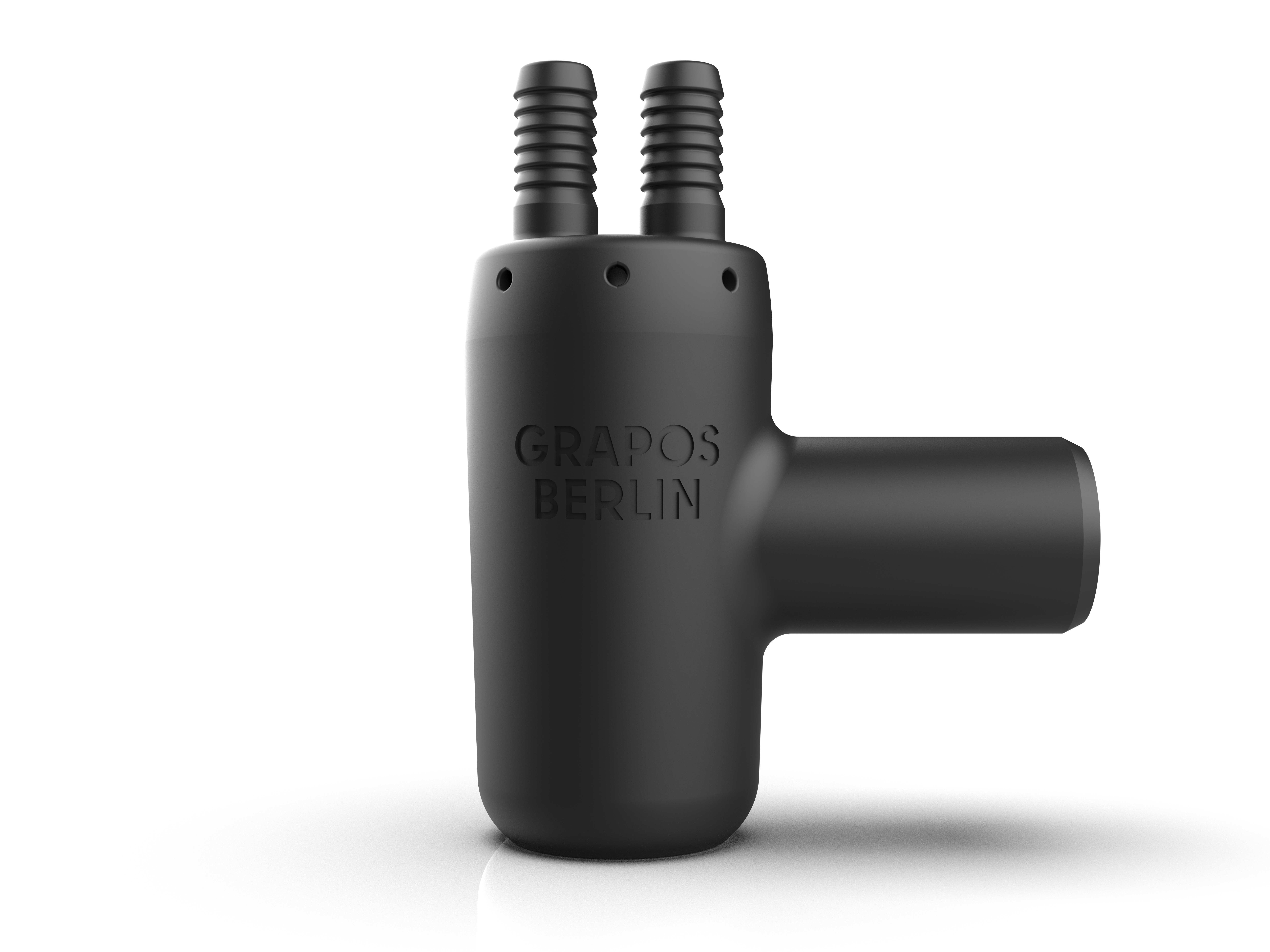
Development of a custom wastewater siphon in 3D printing for an application where no suitable standard solution was available. A watertight assembly of three components with a purpose-built thread and integrated connections — fully designed for additive manufacturing.
Challenge: Need for a siphon in a size and geometry not available on the market — with concurrent requirements for reliable watertightness
Solution: Complete redesign with a custom thread system and print-optimized sealing surfaces
Result: Functional, watertight assembly of three printed parts with fast assembly via screw connection
Project Info
- Services: Concept, design, CAD, thread development, 3D printing, prototyping
- Domain: Functional components · 3D printing · Special construction
- Industry: Sanitary technology · Special applications
- Project type: Custom development · Special component
Background
For a specific application, a wastewater siphon with a particular size and connection geometry was needed. No suitable standard product was available on the market, and adapting existing solutions was neither functionally nor economically sensible.
3D printing offered itself as the solution because functional components like this can be manufactured in a design-appropriate way without tooling costs — even when the component is intended for permanent use. The prerequisite: the design must be conceived for the process from the outset, especially with requirements like watertightness.
Construction & Execution
The siphon consists of three components: outer housing, inner insert, and lid. The entire assembly was designed appropriately for FDM printing — with a focus on printable geometries, minimized support structures, and optimized component orientation. Support material was used selectively at critical points to ensure surface quality at the sealing faces.
The purpose-built thread is the central technical element. Instead of a standard thread, a geometry specifically optimized for 3D printing was designed: adjusted tolerances for reliable sealing, print-friendly flank geometry, and reduced turn count (approx. 1.5 turns) for fast tool-free assembly. Hose nipples and connection geometries are integrated directly into the lid, so no additional parts or adapters are required.
Watertightness results from the interplay of thread tolerance, sealing face geometry, and the print orientation of the individual components — not from additional seals.
Results
- Watertight, functional assembly without external sealing elements
- Precisely fitting solution for an application with no standard alternative
- Assembly via screw connection in seconds, without tools
- Fully reproducible in-house printing, without tooling costs
- Adjustments to changed requirements possible at any time via CAD
Applicability to Other Projects
This approach can be applied to many areas of 3D print design where standard parts do not fit or are not economically viable:
- Custom functional components with technical requirements — e.g. components with sealing, pressure, or load requirements for which no standard solution exists.
- Custom threads and connection elements — print-optimized thread systems for fast assembly, non-standard diameters, or special material combinations.
- Integration of connections and interfaces — hose nipples, plug connections, or adapters built directly into the component rather than combining them as separate parts.
- Spare parts and special components — parts no longer available or needed in too small a quantity, reproduced in 3D printing or newly designed.
- Small series with depth of customization — components where injection molding would be too expensive, but regular adjustments or variants are required.
If you have a similar challenge — whether a specific component or the general question of whether 3D printing makes sense for an application — it can usually be assessed quickly in an initial conversation.
Similar requirements or your own idea?
I support with concept, engineering, and realization.