Modular Shelf System for Postmix
Development of a modular stainless steel shelving system for structured integration of postmix and BiB components.
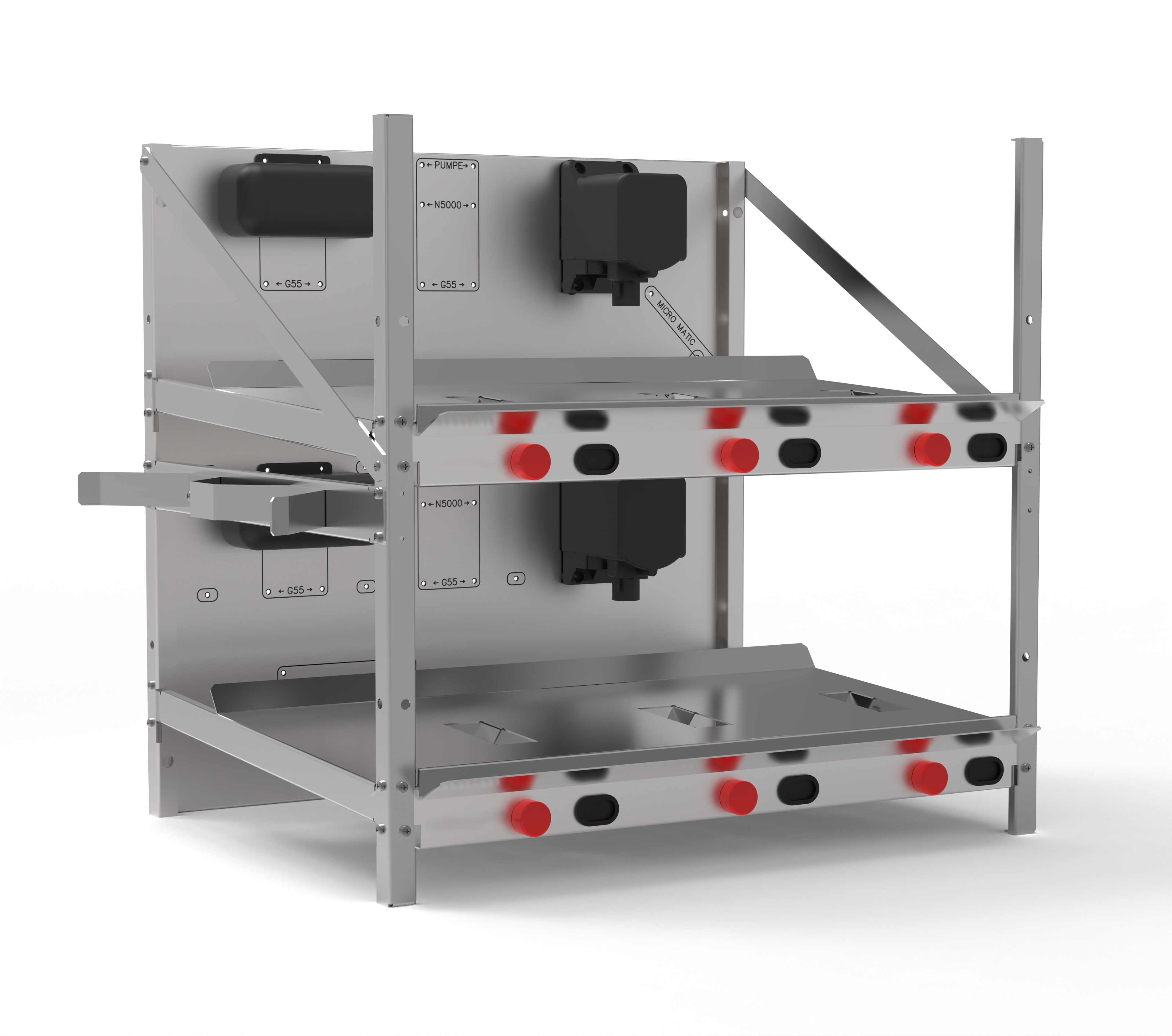
Development of a modular stainless steel shelving system for the structured integration of syrup boxes, pumps, and components of postmix installations. Instead of conventional individual mounting, a pre-structured carrier system was created that reduces installation time, space requirements, and sources of error.
Challenge: Components of postmix installations are typically mounted individually and without a fixed carrier system — making installation and maintenance time-consuming, especially with tight installation windows at the customer site
Solution: Pre-configured, modular stainless steel shelf with defined positions for all components, pre-wired cable and hose routing
Result: Standardized installation in a fraction of the time, with clear structure and visible functional status via integrated LED indicator
Project Info
- Services: Concept, design, CAD, fabrication planning, prototyping, production support, cost calculation
- Domain: Product development · Sheet metal construction · Special machinery
- Industry: Beverage · Gastronomy · Event technology
- Project type: Product development · Near-series system
Background
In the classic setup of postmix installations, syrup boxes, pumps, hoses, and wiring are typically installed as individual components without an overarching carrier system. This is functional, but has practical disadvantages: on-site installation takes a long time, component assignment during maintenance is not always clear, and the available space is not optimally used. This is especially noticeable with tight installation windows at the customer site.
A modular, pre-configured carrier system was to address these points structurally — with a focus on installation time, standardization, and scalability for different plant configurations.
Construction & Design
The system was designed as a modular sheet metal construction in stainless steel. All components are laser-cut and bent; assembly is entirely via screw connections — without welds, which would be problematic in fabrication and cleaning. Defined connection elements enable stacking, so that configurations from a single module to a multi-tier system are possible depending on requirements. An integrated mounting plate at the top allows additional attachment of further plant components.
Material selection and construction are matched to the typical operating conditions in the beverage sector: wet environments, regular cleaning, food contact surroundings.
Component Integration
The real added value comes from the complete integration of all required functions into the construction. The back panel is designed with pre-fabricated holes and threads for the pumps; all component positions are clearly defined. Cable and hose routing is specified through targeted cutouts and integrated brackets in the side structures. This means installation follows a clearly defined sequence — without on-site adjustments being required.
Installation Optimization
Several design details further reduce installation time:
- Laser markings on components for clear identification and assembly sequence
- Pre-assembled cable harnesses that only need to be plugged in
- Pre-mounted or pre-prepared fastening points for all components
- Defined hose routing without subsequent adjustments
- Integrated cable brackets instead of loose attachment
Installation can thus be carried out largely by following instructions, without installation staff needing experience with individual wiring.
Additional Functions
Beyond the pure carrier structure, functional extensions were integrated:
- LED indicator for visualizing box fill levels directly on the shelf
- Optional extensions such as additional brackets, base risers, and add-on parts
- Modular scalability for different plant configurations
Development & Fabrication
The project covered the complete development chain: concept and requirements analysis, CAD design and fabrication drawings, prototype build and evaluation, selection and coordination with fabrication partners, production support, and cost calculation for near-series implementation.
Results
- Significantly reduced installation time at the customer site
- Standardized, reproducible assembly sequence
- Clear component assignment — also for maintenance and service
- Scalable configuration from single module to multi-tier system
- Visual functional status via integrated LED indicator
Applicability to Other Projects
This approach can be applied to many areas of product development where improvised on-site solutions are currently used:
- Modular carrier systems for technical components — when individual parts are currently mounted loosely and this makes maintenance, service, or expansion difficult.
- Reduction of installation time as product value — constructions where on-site installation is the critical bottleneck, not the product itself.
- Sheet metal construction in stainless steel for demanding environments — food, cleanroom, outdoor use, wet areas, or other sectors with hygiene and corrosion requirements.
- Standardization instead of individual fabrication — when a product is currently assembled individually for each deployment, even though the requirements are largely similar.
- Scalable systems instead of individual variants — modular designs that cover different configurations without requiring a separate design for each variant.
If you want to develop a system that simplifies installation, or want to structurally overhaul an existing product — let’s talk.
Similar requirements or your own idea?
I support with concept, engineering, and realization.