Automated Beverage Filling System
Automated filling system with rotary table, conveyor belt, and precise positioning for serial production.
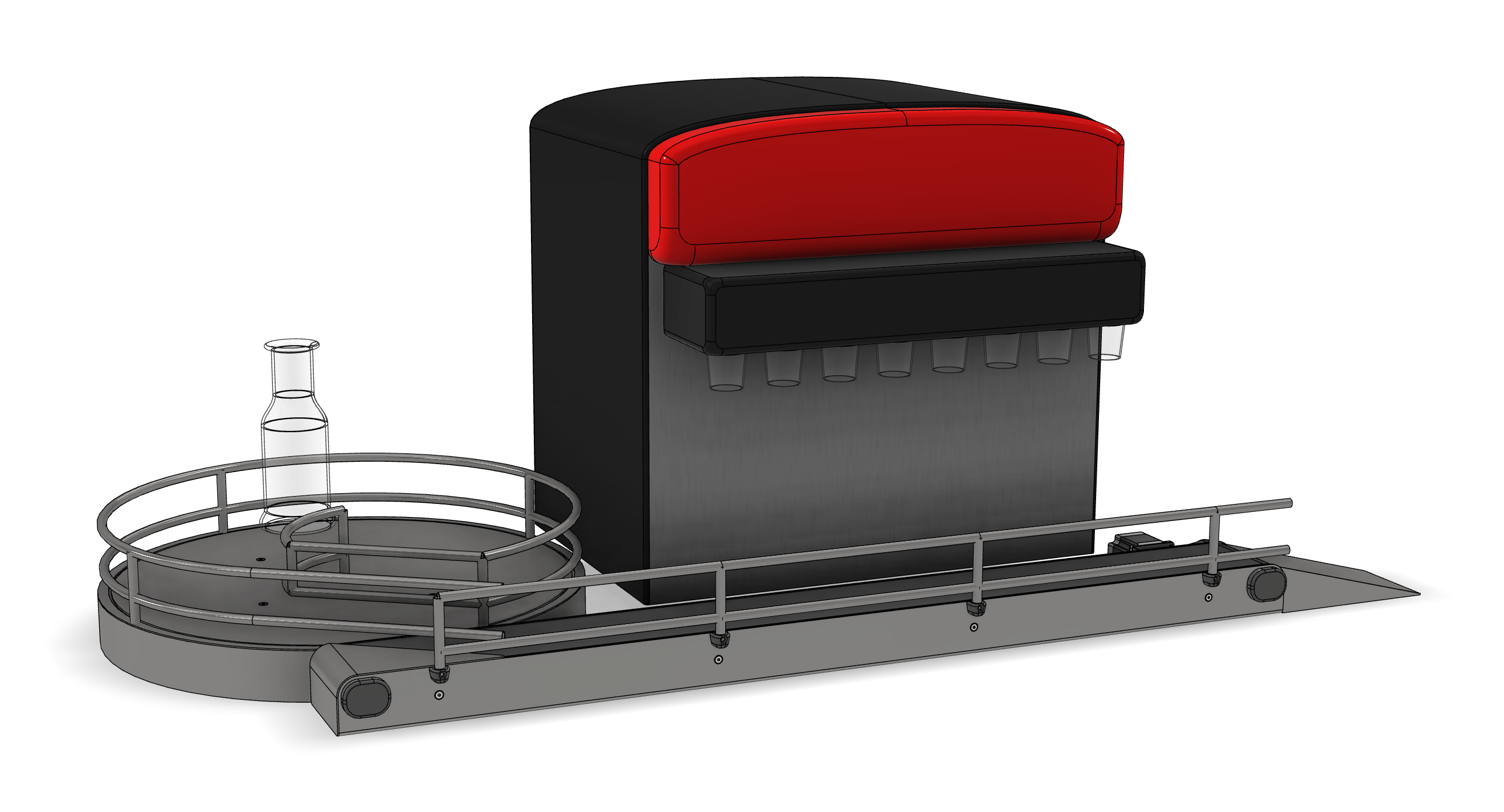
Development of an automated beverage filling system that feeds containers via a rotary table, positions them precisely on a conveyor belt, and transports them after filling. The system combines conveyor technology, sensor systems, and microcontroller control into a continuous process without manual intervention.
Challenge: Manual beverage filling is labor-intensive and hard to reproduce — a system was needed with reliable feeding, precise positioning, and a defined fill quantity
Solution: Combination of rotary buffer table, singulation, stepper motor-driven conveyor belt, and sensors, coordinated via a microcontroller
Result: Functional filling system with reproducible, continuous process flow — built in stainless steel and suitable for hygienic applications
Project Info
- Services: Concept, design, CAD, automation, control development, system integration, prototyping
- Domain: Special machinery · Automation · Mechatronics
- Industry: Beverage · Production · Event
- Project type: Special machine · System development
Background
Manual filling of beverages into containers is labor-intensive and difficult to reproduce: positioning, fill quantity, and cycle rate vary, making it hard to scale to larger volumes. A continuous process required a system that reliably feeds containers, positions them precisely, fills them with a defined quantity, and transports them onward — without manual intervention between steps.
The requirement covered both the mechanical design and the control logic that coordinates all components.
Operating Principle
The process runs automatically after a start or order signal:
- Containers are placed on the rotary table
- The rotary table rotates and feeds containers toward the singulation point
- Via a guide, they are transferred in a controlled manner onto the conveyor belt
- A sensor detects the container’s position
- The conveyor belt positions the container precisely under the filling station
- The defined quantity is dispensed
- The container is transported onward and can be retrieved
The process is designed as a continuous flow, enabling reproducible filling over any number of containers.
Mechanical Design
The rotary table functions as a buffer and feed system for multiple containers simultaneously. It is supported on an axial bearing and driven by a motor with belt drive. An integrated singulation mechanism with guide rails ensures that containers are transferred to the belt individually and in a defined orientation.
The conveyor belt is the central component for positioning accuracy: a specially developed belt conveyor with drive and idler rollers, bilateral bearing support, and a slide plate for smooth, stable running. Lateral guide rails keep containers in the target position. The belt is driven by a stepper motor, enabling exact positioning under the filling station.
The supporting structure and cladding are made of stainless steel (rectangular tube for the frame, sheet metal and guide elements in the appropriate specification) — designed for robust continuous operation and hygienic applications in the beverage sector. The structure is complemented by 3D-printed brackets and fastening elements that allowed rapid adjustments during development.
Control and Sensors
The controller handles the timed coordination of all movements via a microcontroller. A position sensor detects the container on the conveyor belt and triggers positioning under the filling station. The rotary table and conveyor belt are synchronized so that the transfer occurs without backlog or gap.
The control logic processes the start signal, coordinates the motion sequences of rotary table and conveyor belt, monitors container position via sensors, and triggers the filling process once the target position is reached.
Results
- Fully automated filling process without manual intervention between steps
- Reproducible positioning and defined fill quantity per container
- Continuous throughput via rotary buffer and synchronized conveyor belt
- Stainless steel construction for robust continuous operation and hygienic applications
- Modular design — individual components (filling station, sensors, control) can be adapted for other applications
Applicability to Other Projects
This approach can be applied to many areas of process automation and special machinery:
- Automated feeding and singulation systems — rotary tables, vibratory bowl feeders, or linear feeders as buffer and singulation for components, containers, or packaging.
- Precise positioning in manufacturing processes — stepper motor-driven conveyor lines or axes with sensors, where manual positioning is too imprecise or too slow.
- Dosing and filling systems for small series — special machines for products not suited for standard filling lines: non-standard sizes, small volumes, frequent product changes.
- Integration of mechanics, sensors, and control — applications where a continuous process flow matters more than individual components, and where one person understands and designs the entire chain.
- Stainless steel construction for hygienic environments — food, beverage, pharma, or other sectors with cleaning and corrosion resistance requirements.
If you are planning a filling, feeding, or positioning system, or want to optimize an existing one — let’s talk.
Similar requirements or your own idea?
I support with concept, engineering, and realization.