Walkable Spiral Stage for Product Presentation
Construction of a modular, walkable spiral stage for product presentations at events and trade shows.
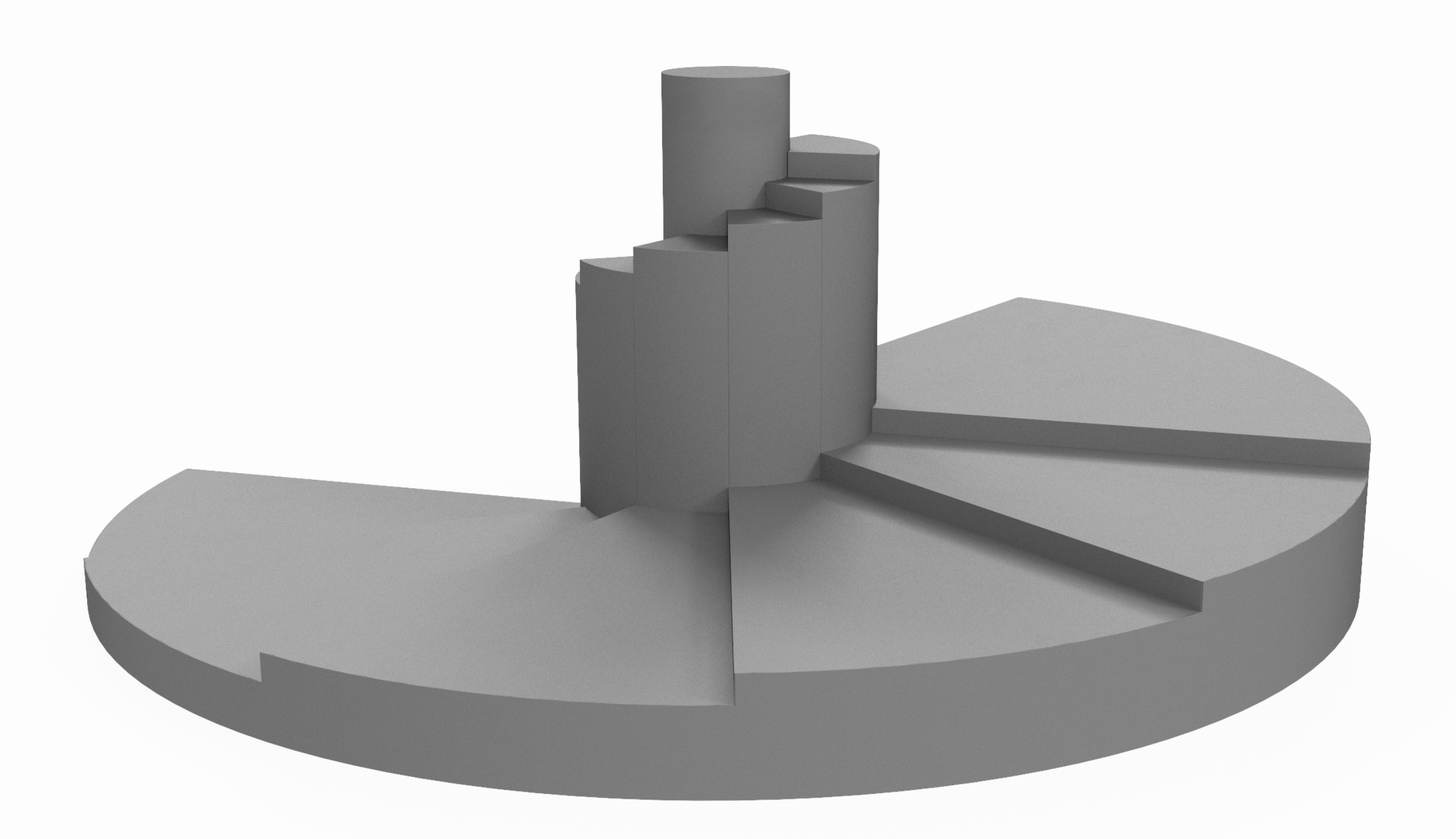
Construction and realization of a walkable, sculptural spiral stage (approx. 5 m diameter) as the centerpiece of a product presentation. The stage is built from identical segments at varying heights — a modular concept that simplifies fabrication, transport, and assembly under real event conditions.
Challenge: Sculptural, walkable stage with spiral geometry — with limited transport dimensions (freight elevator) and a tight setup window on site
Solution: Modular segment system with identical base geometry and varying height, designed for workshop fabrication, transport-friendly components, and fast assembly
Result: Walkable spiral stage as the central presentation element, completed on schedule — with a high-quality surface and clean joint pattern for product staging
Project Info
- Services: Concept, design, fabrication planning, workshop coordination, site supervision, trade coordination
- Domain: Event architecture · Special construction · Stage construction
- Industry: Brand experience · Brand staging · Product presentation
- Project type: Special construction · One-off
Background
For a product presentation, a walkable, sculptural stage was needed as the central spatial element — with a spiral arrangement of platforms at different heights, on which products are staged. The construction had to be visually compelling and logistically feasible at the same time.
The key constraint: maximum component dimensions were limited by the dimensions of a freight elevator in the venue. This made it clear that the stage could not be designed as a closed structure but had to be a segmented system — with all the implications for geometry, joining technology, and assembly sequence.
Requirements
- Walkable, structurally load-bearing construction with high-quality surface
- Spiral geometry with presentation levels at different heights
- Component dimensions within the transport dimensions of the available freight elevator
- Fast and safe on-site assembly
- Standardization to reduce fabrication effort
- Clean joint pattern and consistent surface appearance despite segmented construction
My Role
- Development of the modular segment concept
- Detailed design of all components and connections
- Selection of materials and structural principles
- Coordination with the workshop during fabrication
- Site supervision and trade coordination
- Ensuring smooth installation within the setup window
Construction & Execution
The stage consists of multiple circular segments arranged in a spiral form. All segments share the same base construction and differ only in their height. This standardization reduces fabrication effort and planning time, while the varying height steps create the dynamic, rising form of the spiral. The overall structure has an outer diameter of approximately 5 m; segments are arranged radially and connected in accurate alignment. A central column serves as an additional presentation element and geometric reference point.
The load-bearing structure is designed as a timber frame construction using standard profiles. The deliberate choice of standard cross-sections keeps material availability, costs, and fabrication effort low — without compromising stability or walkability. Each segment was fully prefabricated in the workshop, so that only assembly and connection of segments was required on site.
The visible surfaces create the monolithic impression that visually dissolves the segmented principle: top panels of engineered wood, side cladding of flexible plywood for the continuously rounded outer edge. The use of flexible plywood enables the clean spiral form without complex custom fabrications or milled special geometries.
The connection logic of the segments was a central design challenge: they must be accurately positioned, assembled without rework, and simultaneously transportable through the freight elevator. This constraint fundamentally determined the maximum segment size and therefore the entire geometry concept.
Fabrication & Setup
Fabrication was carried out in close coordination with the workshop — structural details were reviewed and selectively adjusted during production to ensure the quality of connection points and surfaces.
During on-site setup, I took on the trade coordination: transport logistics through the freight elevator, segment assembly sequence, geometry control during setup, and handover to the event team. Through the prepared construction and modular concept, installation could be carried out in an organized manner within the setup window.
Results
- Walkable spiral stage as the central presentation element of the venue
- On-time realization despite limited transport dimensions and tight setup window
- High-quality, monolithically appearing surface for product staging
- Standardized segments significantly reduced fabrication effort
- Clean joint pattern and stable walkability throughout the event duration
Applicability to Other Projects
This approach — realizing complex geometry through standardized modules while accounting for real transport and setup conditions — can be applied to many areas of event architecture and special construction:
- Special construction for stage and platform systems — when a visually strong form is required, but individual fabrication of every component would not be economically viable. Standardization with individually unique overall appearance.
- Event structures with transport restrictions — venues with freight elevators, narrow access, stairwells, or other logistical constraints. The construction must be designed for these from the start, not adapted afterwards.
- Modular systems for trade shows, showrooms, and pop-ups — reusable or reconfigurable structures that adapt to different venues and staging requirements.
- Walkable installations with design ambitions — constructions where structural integrity, safety, and surface quality must all be achieved simultaneously without one compromising the others.
- Projects with short setup phases — structures that must be assembled on site in a few hours or days, with clear setup planning and prefabricated segments.
If you are planning a walkable installation, a trade show stand concept, or sculptural event architecture — let’s talk.
Similar requirements or your own idea?
I support with concept, engineering, and realization.