Interactive Smart Locker for Retail
Engineering and technical implementation of an interactive QR-controlled POS smart locker for retail environments.
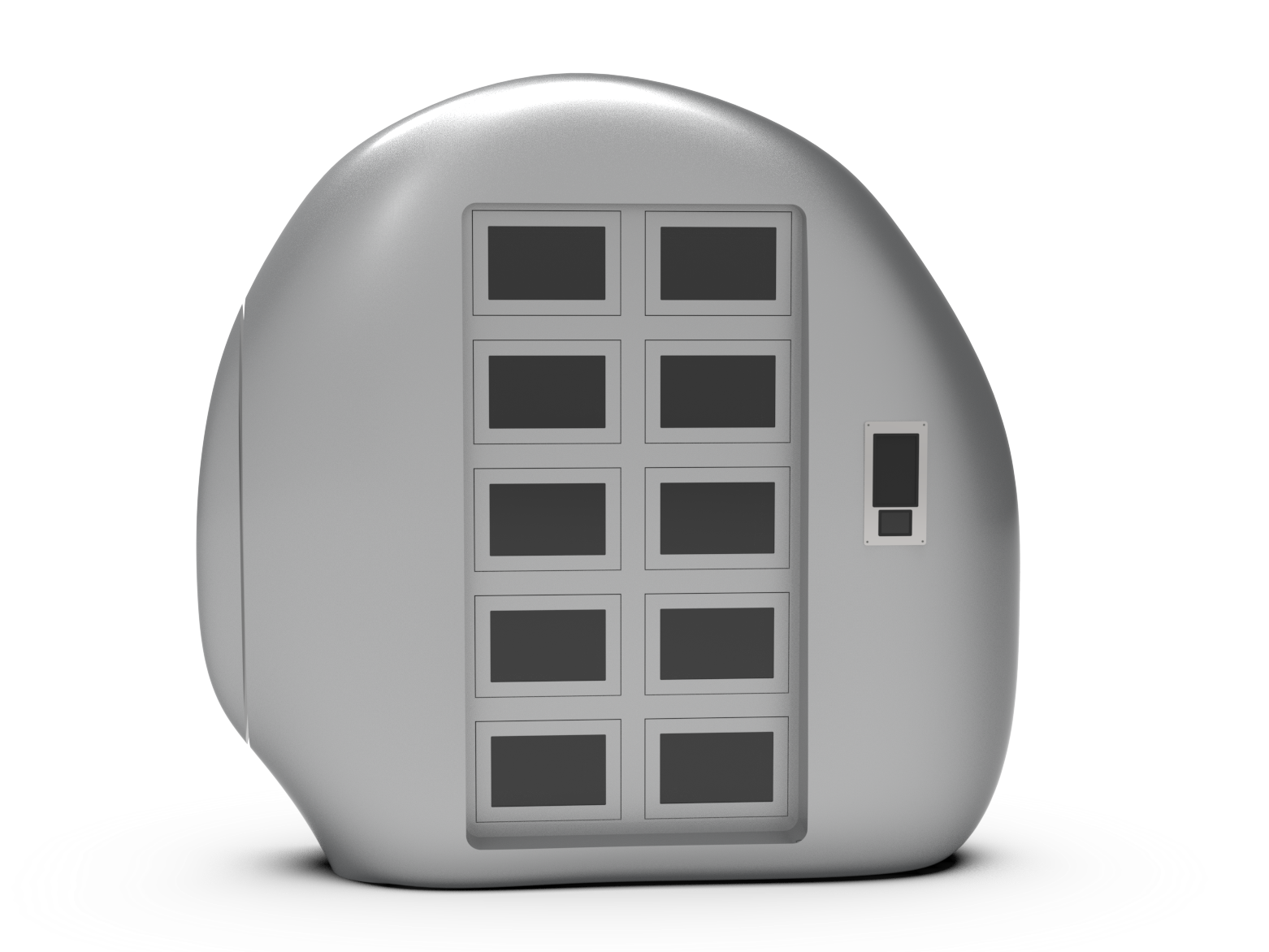
Development of an interactive smart locker system for a time-limited marketing campaign in brick-and-mortar retail. Customers activate the prize draw by scanning a QR code from the customer app; if they win, one of ten illuminated compartments automatically opens with a product and voucher inside. The system combines a timber enclosure, GRP design cladding, electromechanics, and embedded control — as a premium POS object within the store’s interior design.
Challenge: High-quality, store-compatible prize draw system with reliable mechanics and control — with very short development time, changing requirements, and a one-day installation window per store
Solution: Modular overall system of five assemblies, Raspberry Pi control with QR code logic, electromagnetic locks with spring-release opening, GRP “bubble” cladding as design element
Result: Functional prototype in live retail operation — up to 650 successful scans on a single day of use, queues before store opening, uninterrupted fault-free operation throughout
Project Info
- Services: Concept, design, electronics integration, embedded control, 3D printing, workshop coordination, installation
- Domain: Product development · POS installation · Embedded systems
- Industry: Retail · Brand experience · Marketing
- Project type: Prototype · One-off
- Locations: Berlin, London
- Period: October 2024
Background
A fashion retailer wanted to generate additional store footfall during the holiday season in selected stores. The solution: an interactive prize draw system directly at the point of sale, integrated with the existing customer app. Users display their customer number as a QR code, scan it at the device, and go through a prize draw process with light animation. If they win, a compartment opens automatically with a product and voucher.
The system had to work technically reliably — but equally important was its visual impact in the store. Mirrored high-gloss surfaces, illuminated compartments, and a striking “bubble” cladding were intended to integrate the smart locker as a central highlight of the campaign within the high-end store concept.
Requirements
- Functional system comprising QR scan, control logic, light animation, and compartment opening
- Premium design impact within the store’s interior architecture
- Maximum component dimensions for transport and access to stores
- Installation and commissioning within one day per location
- Serviceability despite permanently fixed cladding
- Logic security: each QR code usable only once, max. one compartment openable per hour
- Robust operation across multiple days of use at high usage frequency
My Role
- Development of the overall technical concept
- Functional breakdown into five assemblies (cladding, cabinet, mechanics, operator unit, control)
- Detailed design of all assemblies
- Development and production of 3D-printed components
- Integration of QR scanner, display, lighting, locks, and control
- Assembly of embedded electronics and programming of control logic
- Workshop coordination with the joinery (cabinet) and GRP manufacturer (cladding)
- On-site installation and commissioning
Modular Overall System
The system was divided from the outset into five clearly separated assemblies: cladding, cabinet with ten compartments, electronic opening mechanism, operator unit with scanner and display, control unit. This division arose not only from the logic of the components, but also from the constraints of manufacturing, transport, assembly, and maintenance — each assembly could be developed, manufactured, and serviced independently.
Cabinet and Compartments
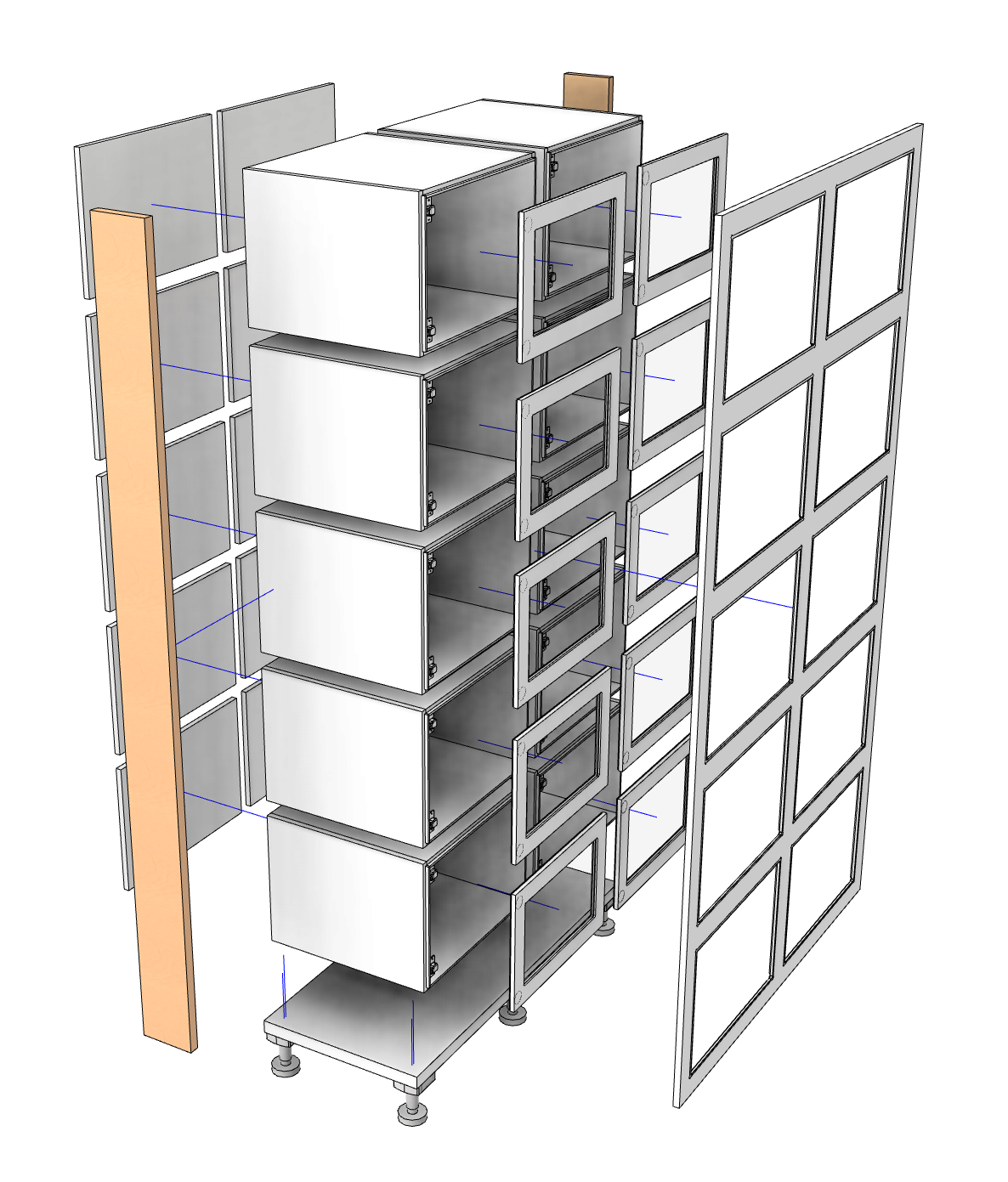
The cabinet was developed together with a joinery workshop and delivered as a CNC-manufactured timber structure fully assembled. The ten compartments were dimensioned based on the minimum required measurements for the prize products and fitted with illuminated interiors, so that winning products were immediately visible when the compartment opened.
Key structural considerations were cable routing for locks and lighting, the arrangement of doors and hinges with regard to the overall appearance, and serviceability: the compartment modules are individually built, each with a removable back panel — individual compartments can be accessed in the event of a fault without having to dismantle the entire cabinet.
Opening Mechanism
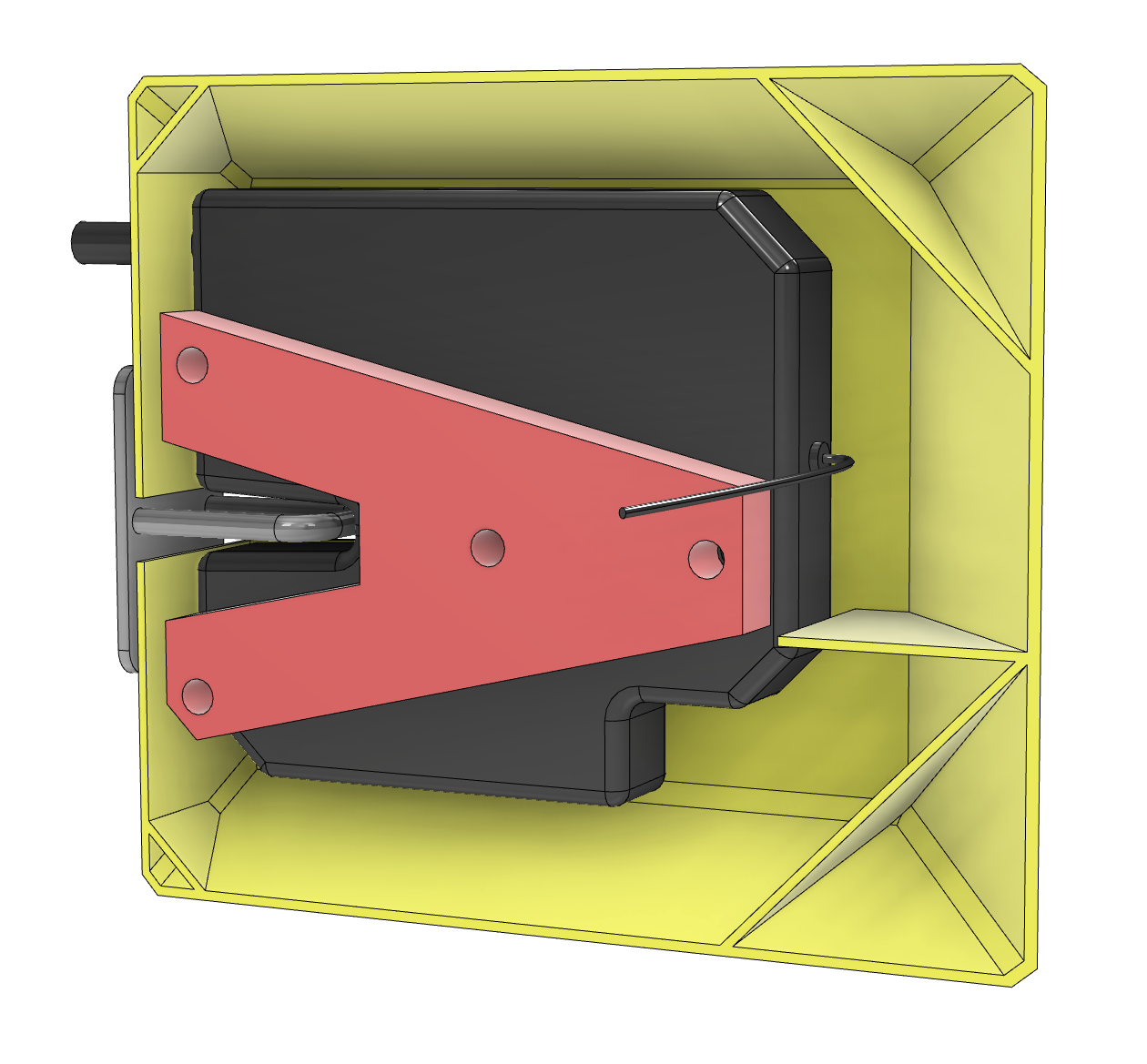
Electromagnetic locks with a spring mechanism were used for reliable compartment release. After electronic release, the door springs open by spring force without requiring an additional mechanical opener — keeping the mechanics simple and low-maintenance.
To ensure the interaction of lock, latch, door, and hinge worked reliably, real full-scale test assemblies were built in advance. This resulted in a series of project-specific 3D-printed components: spacer plates for precise lock positioning, assembly jigs for reproducible drill patterns at the joinery, and covers to protect the mechanics and wiring. The use of additive manufacturing was critical here because tolerances and positions could be iteratively optimized before the final components were integrated into the cabinet.
Operator Unit
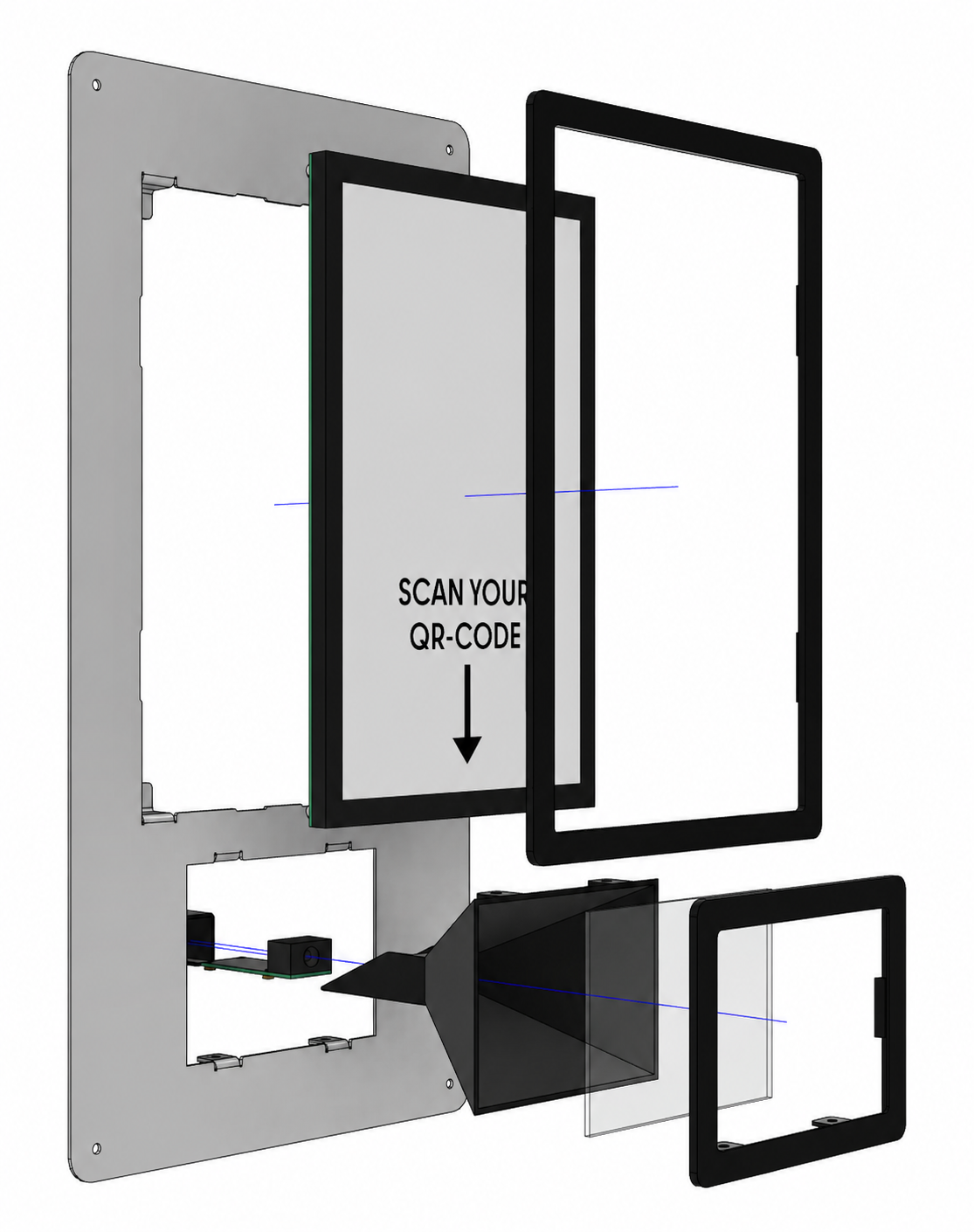
The operator unit is the visible user interface and consists of a QR scanner, 10” display, project-specific housing parts, and a polished stainless steel bezel that houses all visible components. The scanner sits in its own assembly that ensures protection, precise positioning, and a defined scanning distance — an important factor for recognition rate in real operation.
The display handles user guidance with clear status messages: scan prompt, invalid code, already redeemed QR code, running animation, prize status. Client branding elements were integrated directly into the display.
Control Unit
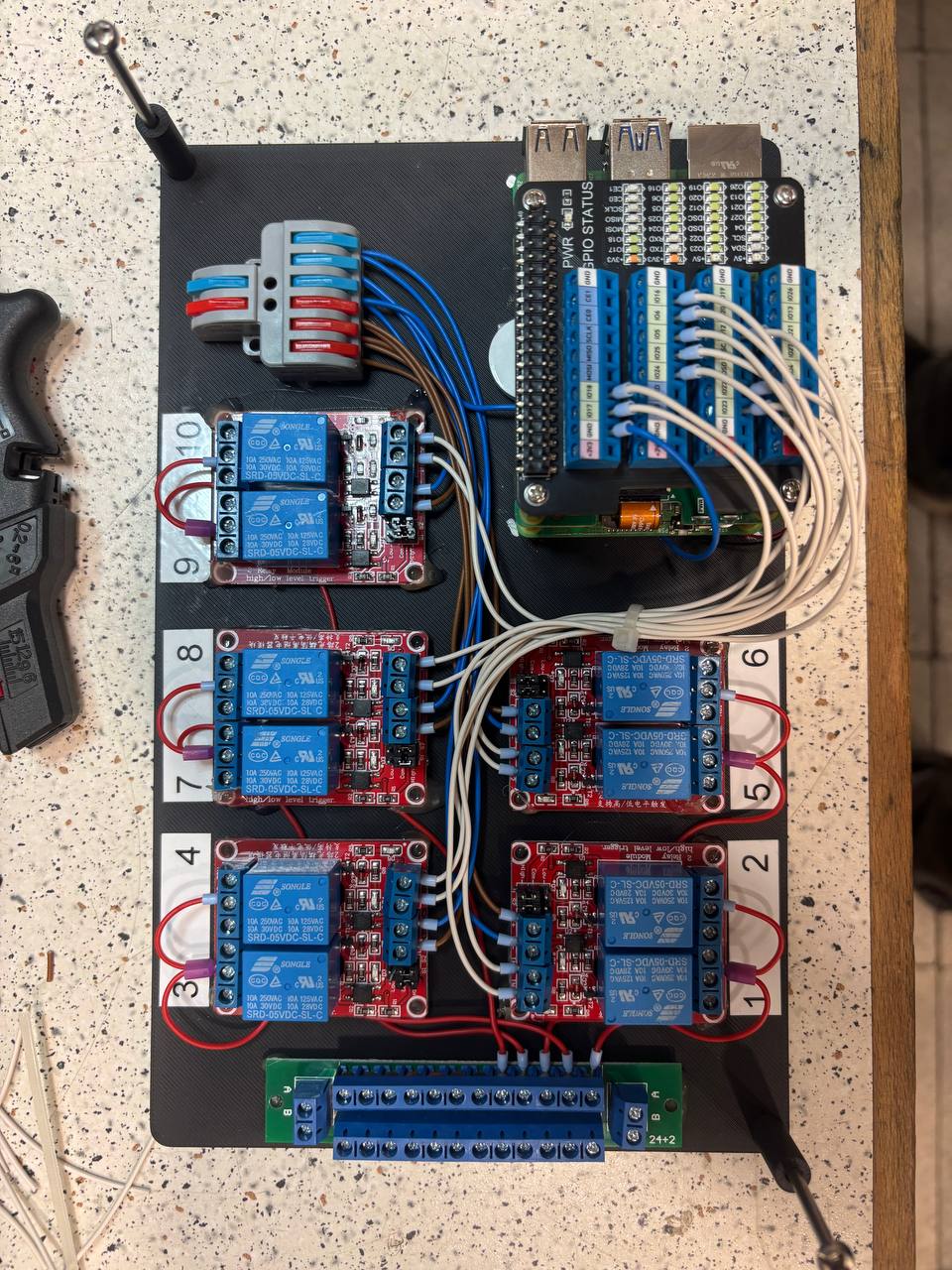
The control is based on a Raspberry Pi with relay control for the 12V electromagnetic locks. It handles evaluation of scanned QR codes, control logic for prize allocation and compartment opening, control of the lighting animation, display output, export of usage data, and remote access for status monitoring during live operation.
The logic safeguard prevents multiple redemptions of the same code and limits prize dispensing to a maximum of one compartment per hour — so the campaign can be managed evenly across days of use. The complete control electronics are housed in a compact enclosure dimensioned to remain accessible through the service opening without dismantling the cabinet.
Design Integration
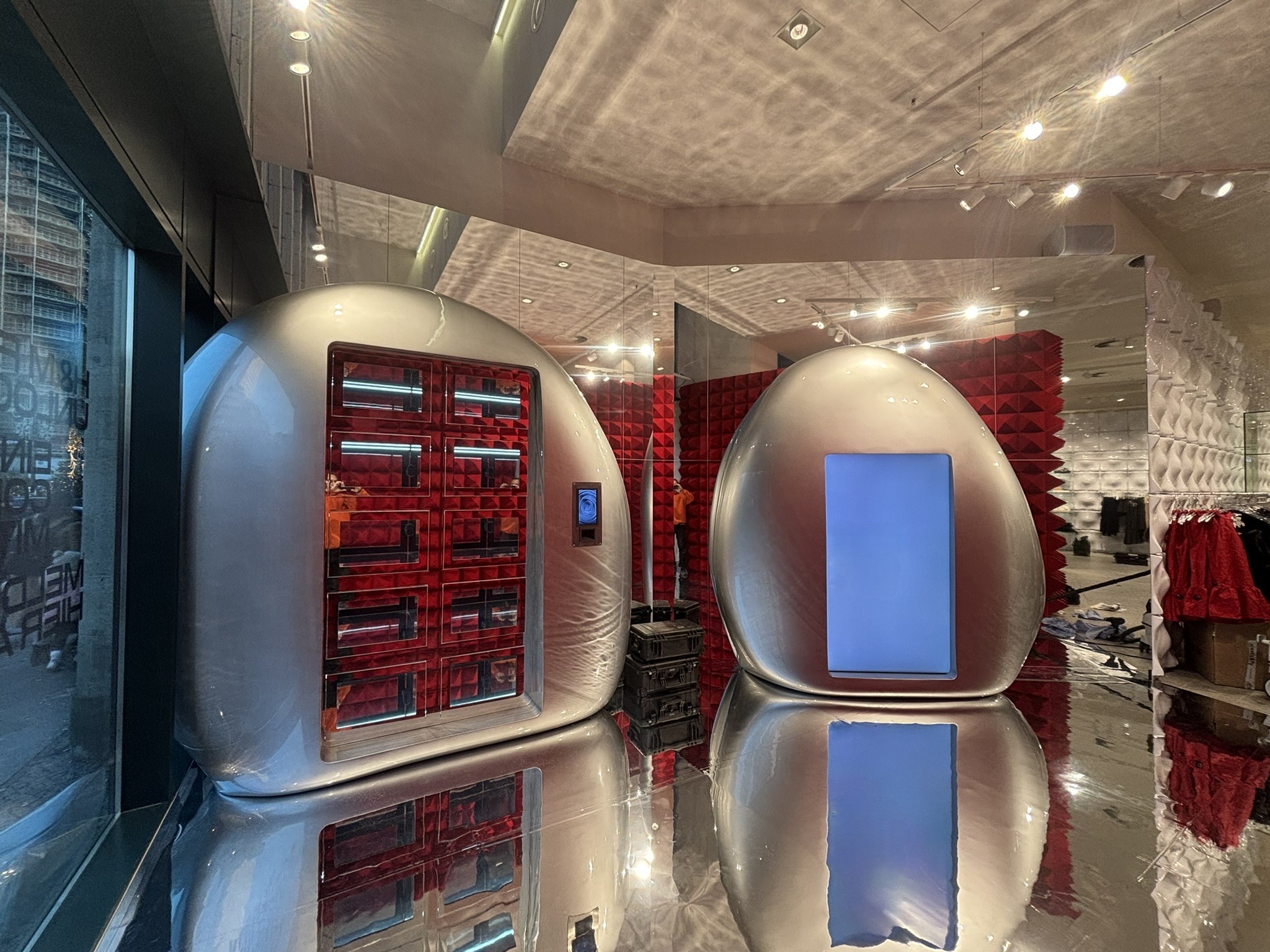
The visual impact was not a secondary consideration, but part of the core task. The smart locker should not be perceived as a technical installation, but as a premium design object in the store. This was achieved through a mirrored surface, the large-format display, the illuminated compartments, and above all the specially manufactured GRP cladding in an organic “bubble” form with high-gloss surface. Form and material were matched to the interior architecture of the stores so that the object functioned as the visual highlight of the campaign.
Results
- Functional prototype in live retail operation across multiple days of use
- Up to 650 successful scans on a single day of use
- Queues before store opening — additional footfall even during typically slow hours
- Consistently fault-free operation across all days of use
- Positive feedback from both the client and on-site users
Applicability to Other Projects
This approach — realizing a technically complex POS installation with high design ambitions as a functional prototype within a short timeframe — can be applied to many areas of retail tech and brand activations:
- Interactive POS installations with app integration — prize draws, personalized activations, or loyalty mechanics that connect the online app and offline hardware.
- Smart locker and dispensing systems in retail — click-and-collect, promotional dispensing, sampling, or product-specific handover systems with QR or NFC authentication.
- Embedded hardware with design requirements — devices where technical function and visual appearance are equally important and should not be developed separately by different contractors.
- Special constructions under time pressure — projects with short development windows, changing requirements, and tight installation windows, where realization should remain in a single hand throughout.
- Mechanics, electronics, and software from one source — applications that require multiple disciplines simultaneously and benefit from one person thinking through control logic, lock mechanics, design, and installation together.
If you are planning an interactive retail installation, a brand activation system, or a technically demanding POS solution — let’s talk.
Similar requirements or your own idea?
I support with concept, engineering, and realization.